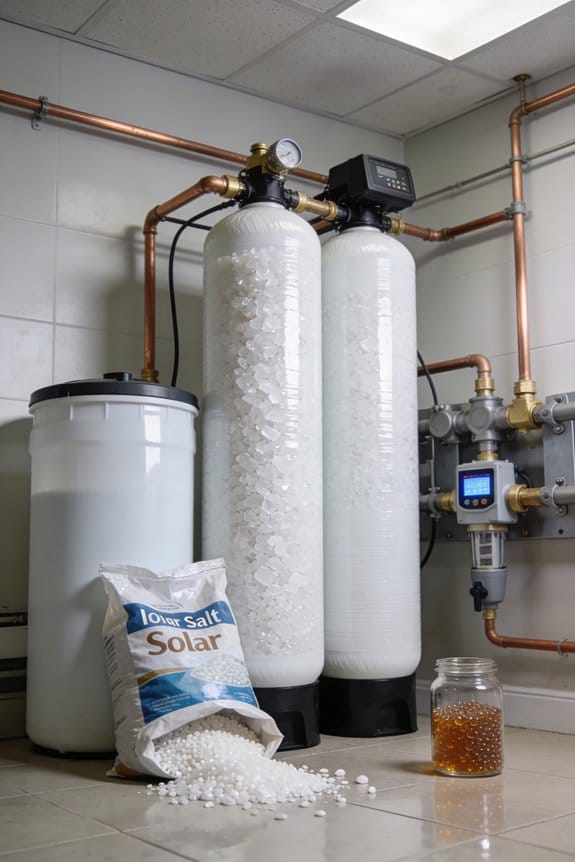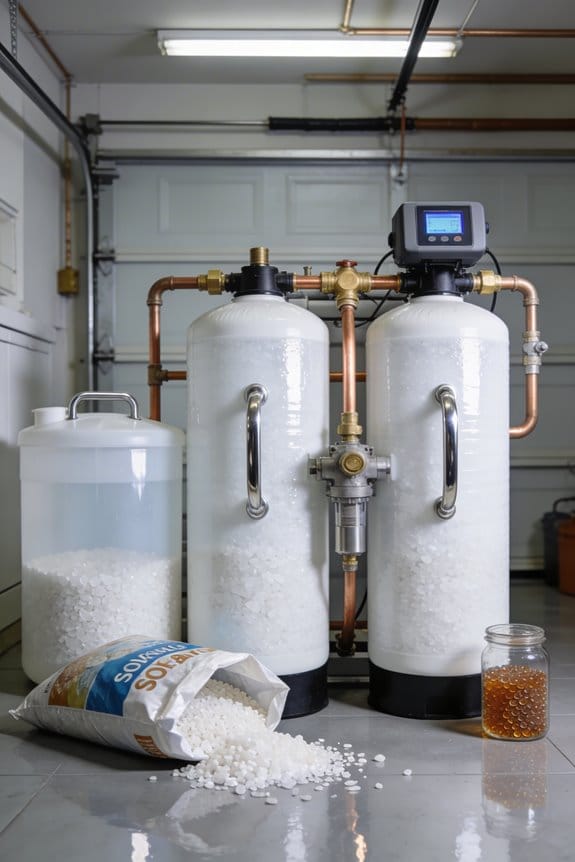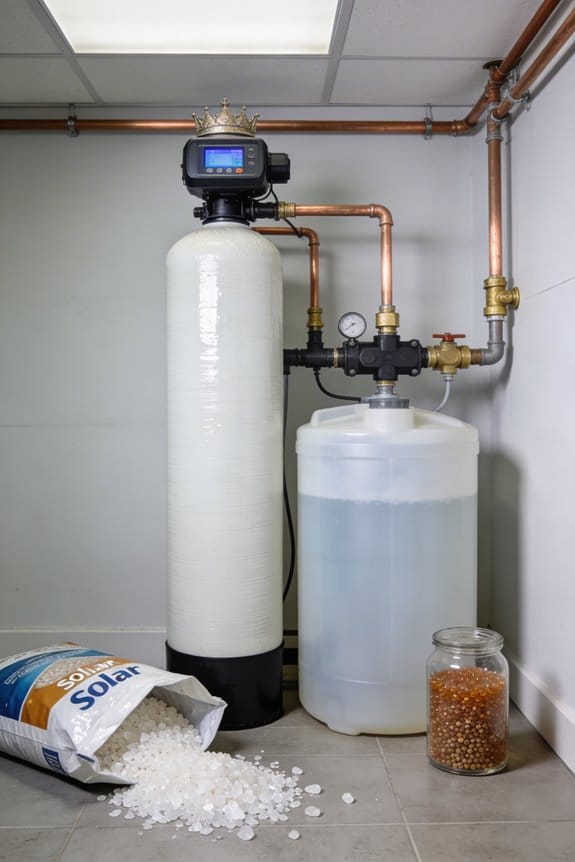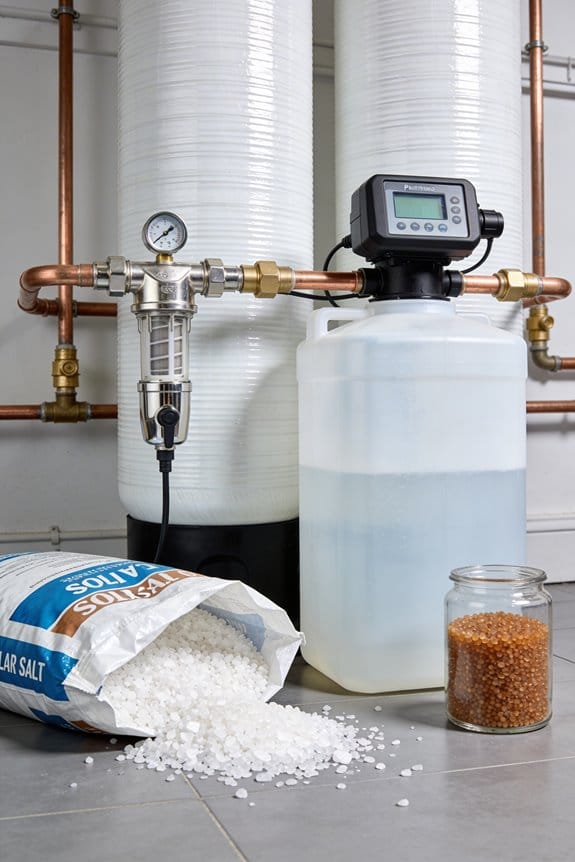
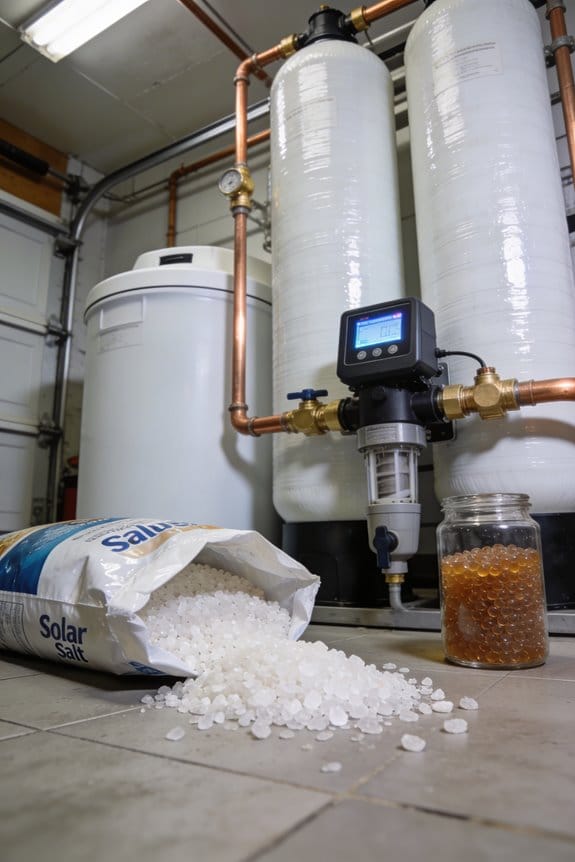

Salt type significantly affects your water softener’s performance because purity determines how efficiently your resin exchanges ions. High-purity salts like evaporated salt (99.6% pure) dissolve completely, minimizing sediment buildup and reducing maintenance needs. Lower-purity rock salt leaves residue that forces your system to work harder and requires frequent cleanings. Matching salt type to your water’s hardness level—using evaporated salt for very hard water or solar salt for moderate hardness—ensures peak efficiency. Understanding which salt works best for your specific situation can extend your system’s lifespan considerably.
Key Takeaways
- Salt purity directly impacts ion exchange efficiency; high-purity salts enable better resin performance and cleaner brine.
- Rock salt causes frequent brine tank buildup and clogs, forcing systems to work harder than evaporated or solar salt.
- Evaporated salt (99.6%+ purity) dissolves fastest, minimizes residue, and requires significantly less maintenance over time.
- Potassium chloride is 30% less efficient at softening water and causes more frequent regenerations than sodium chloride.
- Matching salt type to water hardness ensures optimal performance; very hard water demands higher-purity evaporated salt.
How Does Salt Purity Affect Your System’s Performance?
Salt purity—the measure of how much actual sodium chloride (or potassium chloride) is in your salt product versus impurities—directly impacts how well your water softener works and how much maintenance you’ll need to perform. When you use high-purity salt, fewer impurities enter your brine tank, which means less sediment buildup occurs. This cleaner brine solution performs the ion exchange process more efficiently, allowing your resin to exchange hardness minerals more effectively. Lower-purity salts like rock salt leave residue behind, forcing your system to work harder and potentially shortening your resin lifespan. Higher-purity options, such as evaporated salt at 99.6% or better, minimize clogs and reduce the frequency of tank cleanings, ultimately extending your system’s operational life and maintaining consistent water softening performance.
Recommended Products

Compact design for space-saving installation: The one-tank compact design of the iSpring WCS50KG whole house water softener helps save valuable space in your home, making it easier to install in tight or limited areas. The system is designed for indoor installation and is intended for cold water supply only. It features an inlet/outlet connector with the options of 1" or ¾" NPT, providing flexibility and compatibility with different plumbing setups.

Perfect for Families Large or Small: Designed for households of 1–5+ people dealing with hard water. The EcoPure EP42 treats up to 42,000 grains and removes up to 11 ppm of clear water iron, protecting your entire home from scale buildup and stains
High flow whole house water softener for larger homes
Best Water Softener Salt for Your Water Hardness Level

Choosing the right salt type becomes easier once you understand your water’s hardness level, since different salts perform best under different conditions. For moderate hardness, solar salt works well because it balances cost and purity effectively. If you’re dealing with very hard water, evaporated salt‘s superior purity of 99.6% or higher prevents residue buildup and clogs. Rock salt suits only mild hardness situations despite its affordability. Consider grain size when purchasing, as smaller crystals dissolve faster in your system. Your seasonal usage matters too; heavier use demands higher-purity options that maintain efficiency year-round. Follow your water softener’s manufacturer recommendations carefully, since using the wrong salt type for your hardness level can reduce effectiveness and require costly repairs.
Recommended Products

PROTECTS PLUMBING AND APPLIANCES FROM HARD WATER SCALE WITH ZERO WATER WASTE FILTERS DIRT, SAND, SILT, CLAY, RUST, AND OTHER DEBRIS WITH REUSABLE SEDIMENT FILTER CARTRIDGE CAN BE USED FOR HOMES WITH UP-TO 5 BATHROOMS EASY INSTALLATION, LOW MAINTENANCE 120-DAY SATISFACTION GUARANTEE

Salt-Free Scale Prevention & Healthy Minerals Retention: Our Whole House Salt-Free Water Softener utilizes an advanced ion exchange resin to effectively inhibit scale formation throughout your home's plumbing and appliances. Unlike traditional softeners, it smartly retains beneficial calcium and magnesium minerals in your water, providing scale-free protection without removing healthy elements

Aquasana SimplySoft 40,000 Grain Water Softener Base Tank & Cabinet System is ideal for homes with up to 5 people and 4 bathrooms. This system comes with a 5/10-Year Limited Warranty so you can be confident in your purchase. Call 866-662-6885 for customer service and installation support.
Why Pure Salt Means Fewer Cleanings and Repairs
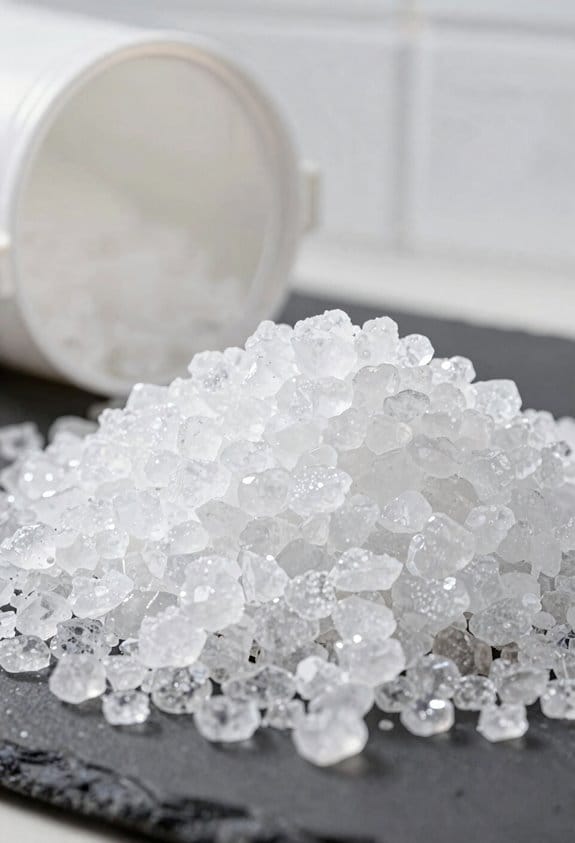
When you use higher-purity salt in your water softener, you’re investing in a system that requires markedly less maintenance over time. I’ve found that evaporated salt, with its 99.6% purity level, produces minimal residue compared to rock salt options. This difference matters because impurities accumulate in your brine tank, creating mineral buildup that clogs your system and forces frequent cleanings.
Pure salt improves brine efficiency, meaning your softener regenerates more effectively with less waste. When I use higher-quality salt, the ion exchange process works smoothly without sediment interruptions. Rock salt, containing more impurities, requires regular tank maintenance and repairs. By choosing evaporated or solar salt instead, you’re reducing the frequency of cleanings considerably while extending your system’s overall lifespan and performance capability.
Rock Salt vs. Solar Salt vs. Evaporated Salt: A Direct Comparison
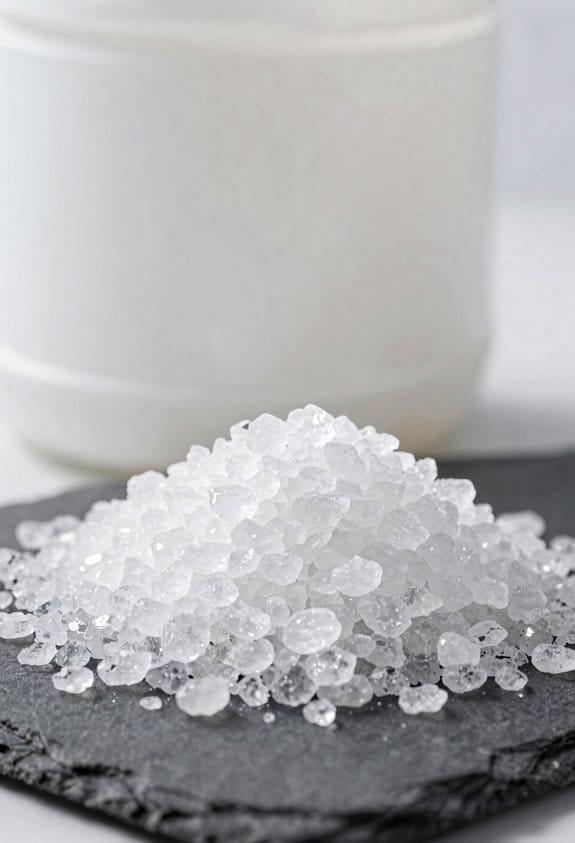
To get the best performance from your water softener, you’ll need to understand how the three main salt types differ in purity, cost, and maintenance requirements. Rock salt contains the most impurities, which accumulate as mineral buildup in your brine chamber and require frequent cleaning. Solar salt offers better purity at a moderate price, dissolving more efficiently than rock salt due to its smaller grain size. Evaporated salt provides the highest purity at 99.6%, ensuring the fastest dissolution rate and minimal residue. While rock salt is cheapest, solar salt balances affordability with performance. Evaporated salt costs more but prevents long-term maintenance issues. Your choice depends on water hardness and budget constraints.
Recommended Products

Aquasana SimplySoft 60,000 Grain Water Softener Base Tank & Cabinet System is ideal for larger homes of 5+ people and 4+ bathrooms and those seeking enhanced performance. This system comes with a 5/10-Year Limited Warranty so you can be confident in your purchase. Call 866-662-6885 for customer service and installation support.

Bulk Purchase: 6 bags of high-quality water softener salt crystals, with each bag weighing 40 lbs.

Contains one (1) API AQUARIUM SALT Freshwater Aquarium Salt 50-Pound Box
Should You Choose Potassium Chloride Instead?

While sodium-based salts dominate the water softening market, potassium chloride presents a distinct alternative that addresses specific health and environmental concerns. If you’re watching your sodium intake due to dietary restrictions, potassium chloride offers a low-sodium solution. However, I’d recommend considering the cost tradeoffs carefully. Potassium chloride costs considerably more than sodium options, and it’s 30% less efficient at softening water, meaning your system works harder and regenerates more frequently.
Additionally, potassium chloride can harden in temperature fluctuations, potentially causing equipment issues. It’s also better for the environment since it reduces sodium discharge into ecosystems. Choose potassium chloride only if health concerns genuinely outweigh higher expenses and reduced performance for your household’s situation.
Recommended Products

Sodium chloride tablets may be used to replace the sodium lost from the body and thereby return sodium chloride levels to normal.

F125050000 4PK WTR Soft Salt Bar - Quantity 1

240 lbs Total Supply (6 x 40 lb Bags) – Long-lasting value pack designed to keep your water softener running efficiently with fewer refills.
Signs You’re Using the Wrong Salt Type
Using the wrong salt type can create several noticeable problems in your water softener system, and recognizing these signs early helps you avoid costly repairs. You might notice gritty buildup accumulating in your brine tank, which indicates excessive impurities from low-quality salt. If you’re experiencing a taste change in your water, it suggests improper regeneration or mineral breakthrough. Your water may feel slippery or appear cloudy, signaling incomplete softening cycles. Additionally, you’ll notice increased maintenance demands, frequent system backwashing, or reduced water pressure throughout your home. When your softener requires more frequent salt refills than expected, that’s another red flag. These warning signs mean you should evaluate your salt choice against your manufacturer’s recommendations and your water’s specific hardness level.
Recommended Products
Perfect for Families: Designed for households of 1–4 people battling hard water. The EcoPure EP31 treats up to 31,000 grains to protect your home from mineral buildup, stains, and scale damage

STOP SCALE BUILDUP: HydroFLOW’s technology prevents scale from forming in your home’s water systems, keeping your faucets and shower nozzles running smoothly and efficiently.

[Revolutionary Water Treatment] Experience unparalleled water quality enhancement with iSpring EDV2 electronic descaler. Say goodbye to hard water woes without resorting to chemicals, salt, or tedious maintenance. Witness a noticeable improvement in just 12 weeks.
Frequently Asked Questions
How Often Should I Replace the Salt in My Water Softener Tank?
I’d recommend checking your brine tank monthly to establish your replace frequency. Most households refill every four to twelve weeks based on water hardness and usage. Follow your system’s maintenance schedule for peak performance.
Can I Mix Different Types of Salt in My Water Softener?
I’d advise against mixing different salt types in your softener. You’ll face cross contamination risks when mixing granules, compromising efficiency and potentially damaging your system. Stick with one type consistently.
Does Salt Type Impact the Cost of Operating a Water Softener?
Yes, salt type markedly impacts your operating costs. I’d recommend evaporated salt despite higher upfront prices—it reduces energy usage and maintenance expenses, lowering your lifecycle costs substantially over time.
What Is the Ideal Salt Level to Maintain in My Brine Tank?
I’d recommend keeping your brine tank filled to about three-quarters capacity for peak level maintenance. This brine concentration guarantees your water softener regenerates efficiently while preventing salt bridges and minimizing tank overflow issues.
How Does Water Temperature Affect Salt Performance in Softening Systems?
Temperature’s literally a make-or-break factor for your softener. Cold water dramatically slows resin efficiency and delays regeneration timing, while warmer conditions accelerate the process. I’d monitor your water temperature closely.