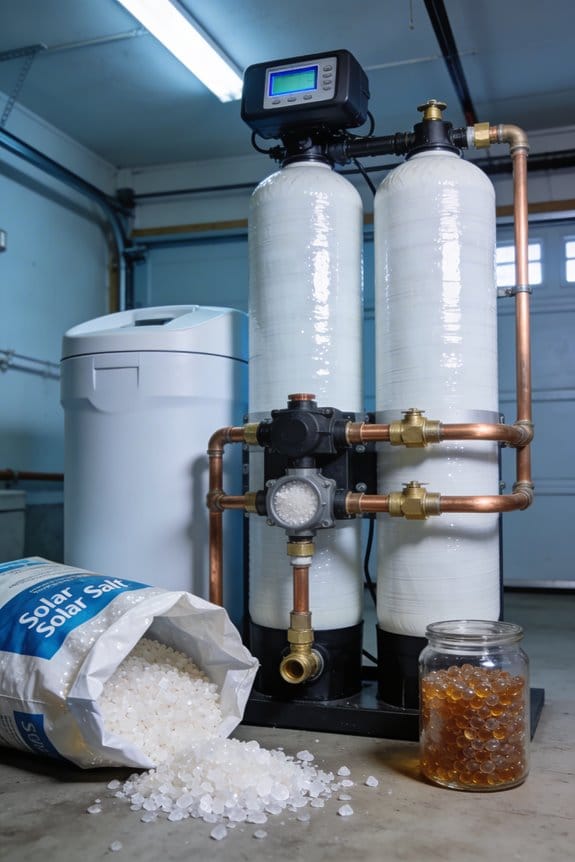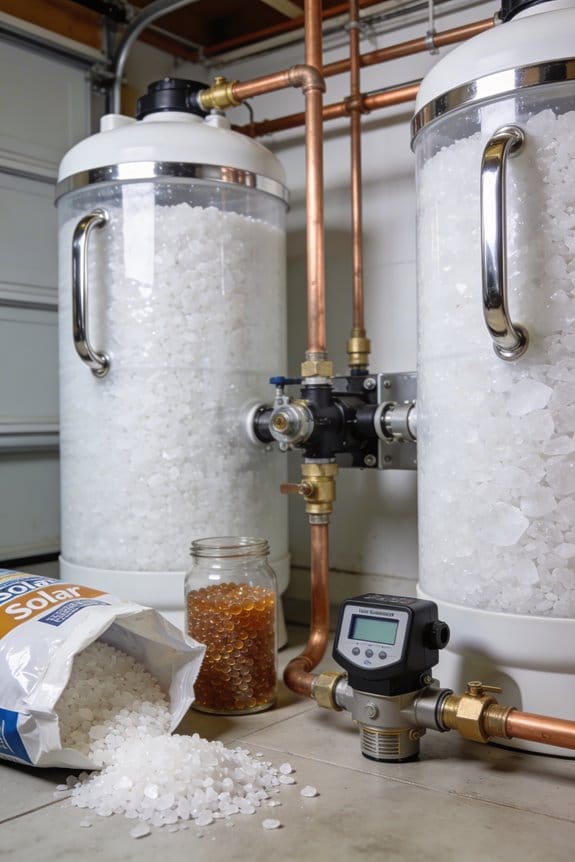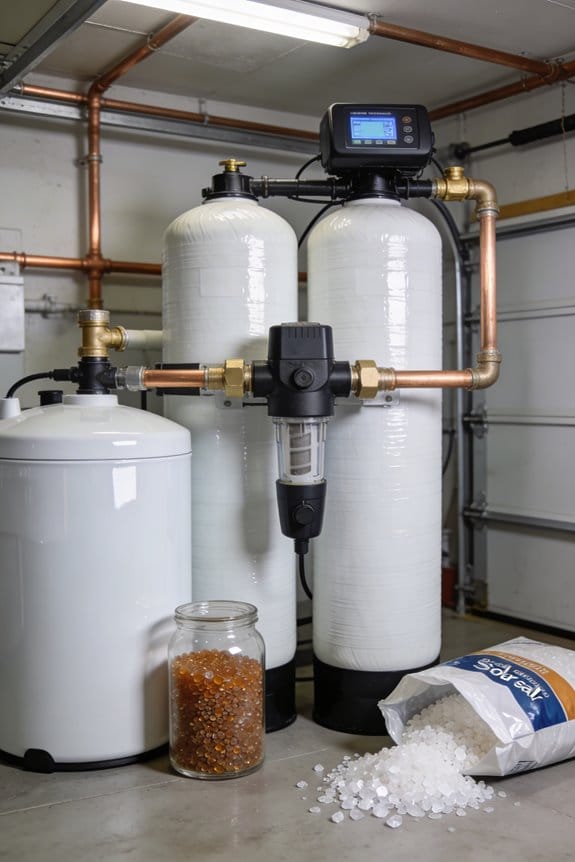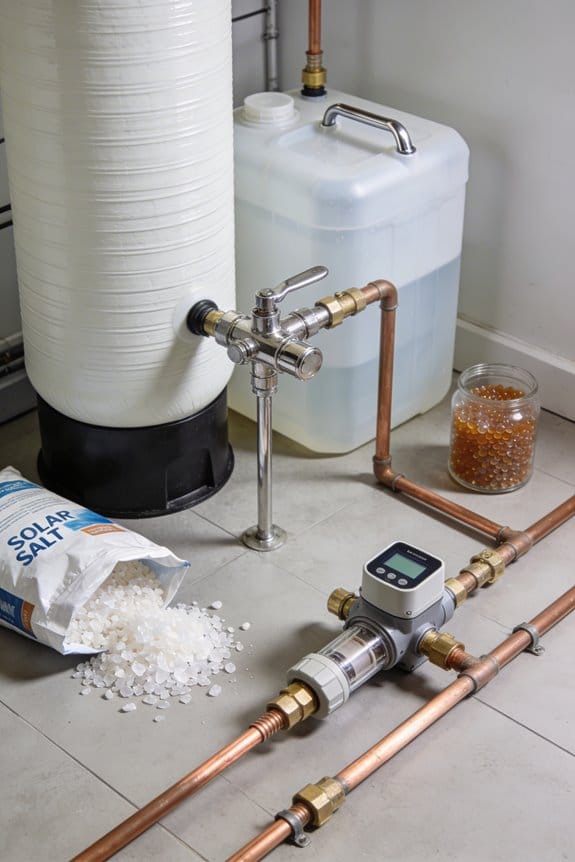

A 4-bedroom home needs a continuous flow rate of 10–15 gallons per minute (GPM) from its water softener. This capacity guarantees adequate pressure when you’re using multiple fixtures simultaneously, like showering while the washing machine runs. Insufficient GPM causes weak water pressure and reduced hot water delivery throughout your home. Your tank size and resin bed must work together to process water quickly enough for peak demand. Understanding how flow rate connects to your household’s daily grain load reveals why proper sizing prevents costly problems down the road.
Key Takeaways
- A 4-bedroom home typically requires 10–15 GPM continuous flow rate for optimal water softener performance.
- Peak flow demands occur during simultaneous fixture use, such as showers, laundry, and dishwashing running together.
- Inadequate GPM causes weak water pressure and reduced hot water delivery throughout the home.
- The resin bed must process water quickly enough to meet flow demands without bottlenecks.
- Properly matching tank size and flow specifications prevents performance drops during peak usage periods.
Calculate Your Daily Grain Load: The First Sizing Step
To determine if your water softener will handle your home’s needs, you’ve got to start by calculating your daily grain load, which is the total amount of hardness minerals your household uses in one day. I’ll walk you through this process, which forms the foundation for selecting the right softener capacity.
First, you need your water hardness in grains per gallon (GPG). Test your water or check your local water report for meter accuracy. Next, multiply your household size by 80 gallons per person daily. Then multiply that number by your GPG hardness level. Account for seasonal variation, since water usage fluctuates throughout the year. This calculation reveals exactly how many grains your softener must remove daily, guiding your capacity selection.
Recommended Products

✅𝗘𝗙𝗙𝗜𝗖𝗜𝗘𝗡𝗧 𝗪𝗔𝗧𝗘𝗥 𝗦𝗢𝗙𝗧𝗘𝗡𝗜𝗡𝗚: Our WECO UXC-1665 water softener system is designed to prevent mineral scale buildup on sinks, faucets, shower doors, and plumbing fixtures. This compact water softener reduces the need for frequent scrubbing and cleaning, making maintenance easier for residential and commercial spaces.
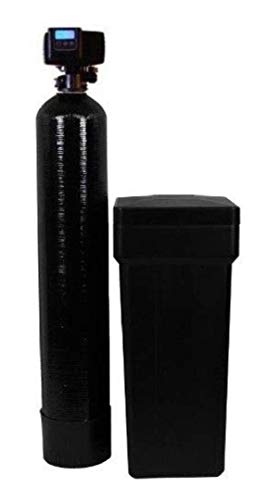
High flow whole house water softener for larger homes

Powerful Softening: This water softener system reduces over 90% of calcium and magnesium ions from hard water, effectively reducing scale buildup. The 2.12cu. ft. resin can treat up to 64,000 grains of hardness, ideal for small to mid-size households
What Tank Size You Actually Need (Based on Hardness and Household Size)
Once you’ve calculated your daily grain load, the next step is matching that number to the right tank size, which directly determines how often your softener needs to regenerate and whether it’ll actually keep up with your household’s water demands.
A 4-bedroom home with 10 GPG hardness typically needs a 1.0 to 1.25 cubic foot tank, handling 3,200–4,500 grains daily. Undersizing forces frequent regenerations, wasting salt and water while reducing resin lifespan. Oversizing increases installation cost but extends the time between regenerations to your target of 7–10 days.
I recommend sizing up slightly for peak usage periods and occasional guests, ensuring consistent soft water without premature equipment wear.
Recommended Products

Perfect for Families Large or Small: Designed for households of 1–5+ people dealing with hard water. The EcoPure EP42 treats up to 42,000 grains and removes up to 11 ppm of clear water iron, protecting your entire home from scale buildup and stains

Aquasana SimplySoft 60,000 Grain Water Softener Base Tank & Cabinet System is ideal for larger homes of 5+ people and 4+ bathrooms and those seeking enhanced performance. This system comes with a 5/10-Year Limited Warranty so you can be confident in your purchase. Call 866-662-6885 for customer service and installation support.

Perfect for homes with 3 to 4 bathrooms and up to 5 family members, who desires softened water and clean, chemical-free water for the whole family.
Flow Rate Matters: Why 10-15 GPM Prevents Cold Showers

You’ve sized your tank correctly, but here’s what many homeowners overlook: a properly sized tank means nothing if your softener can’t deliver water fast enough when your household needs it most. Peak pressure demands during morning routines—multiple showers running simultaneously—require adequate flow rate capacity. Most 4-bedroom homes need 10-15 gallons per minute (GPM) continuous flow to handle simultaneous fixtures without performance drops. Insufficient GPM causes weak water pressure and disappointing hot water delivery, leaving you with frustratingly cold showers. Your softener’s resin bed must process water quickly enough to meet demand, which depends directly on its cubic footage. Matching your tank size to appropriate flow specifications prevents bottlenecks when your family needs reliable water pressure most.
Recommended Products

AFWFilters Platinum air injection system to remove the highest levels of iron and sulfur from your water without using chemicals or salt. Just uses air and your water.
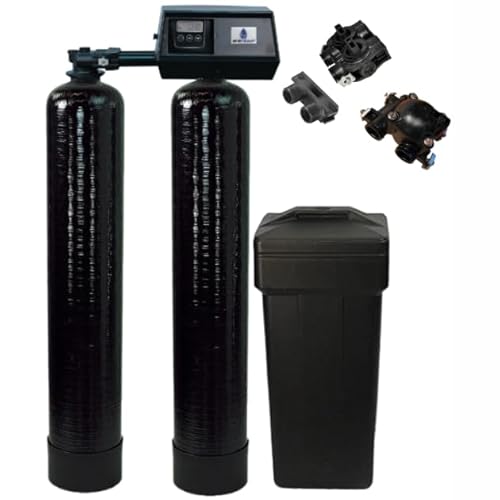
The AFWFilters Complete Twin Tank Water Softener is an innovative solution designed to ensure a constant supply of soft water. Unlike traditional single-tank systems, this twin-tank design allows for one tank to undergo the regeneration process while the other continues to provide soft water. This means you’ll never experience a downtime in soft water availability, making it ideal for households with high water usage or those who simply want the convenience of uninterrupted service.

Compact design for space-saving installation: The one-tank compact design of the iSpring WCS50KG whole house water softener helps save valuable space in your home, making it easier to install in tight or limited areas. The system is designed for indoor installation and is intended for cold water supply only. It features an inlet/outlet connector with the options of 1" or ¾" NPT, providing flexibility and compatibility with different plumbing setups.
Sizing a 4-Bedroom Home by the Numbers

While flow rate determines how quickly water reaches your fixtures, the grain capacity of your softener determines how long it operates before needing regeneration, and both factors depend on accurate sizing calculations. I’ll walk you through the process using your household’s water budget and resin life expectations.
Start by multiplying your household size by 80 gallons per person daily. For a 4-bedroom home with 5 occupants, that’s 400 gallons. Next, multiply this by your water hardness in grains per gallon. At 10 GPG hardness, you’re looking at 4,000 grains daily. Since you want 7-10 days between regenerations, you need a softener rated for approximately 28,000-40,000 grains capacity, requiring a 1.0 to 1.25 cubic foot resin tank.
Recommended Products

Complete Twin tank water softener provides continuous soft water. Ships Loaded

Fleck 9100 SXT Digital Metered Dual Tank Control Valve for 24/7 Soft Water

【 PERFECT FOR LARGE HOUSEHOLDS】 Ideal for 6-8 people with up to 6 bathrooms on city, municipal, and well water sources, this heavy-duty whole house water softener system delivers ultra-soft water to every tap.
Why Undersizing Costs You Money and Headaches

If you install a water softener with insufficient grain capacity for your household’s needs, you’ll face frequent regeneration cycles that drain your wallet through excessive salt consumption and increased water waste. An undersized unit forces your system to regenerate more often, multiplying your long term maintenance costs markedly. You’ll also encounter warranty issues, as manufacturers typically void coverage when systems operate outside recommended parameters. Additionally, frequent regenerations mean your softener ages faster, shortening its lifespan considerably. The resin inside degrades quicker under constant strain, reducing its effectiveness over time. What seems like a budget-friendly choice initially becomes expensive through higher utility bills, salt purchases, and premature replacement needs. Proper sizing prevents these costly complications entirely.
Recommended Products

Complete Twin tank water softener provides continuous soft water

PROTECTS PLUMBING AND APPLIANCES FROM HARD WATER SCALE WITH ZERO WATER WASTE FILTERS DIRT, SAND, SILT, CLAY, RUST, AND OTHER DEBRIS WITH REUSABLE SEDIMENT FILTER CARTRIDGE CAN BE USED FOR HOMES WITH UP-TO 5 BATHROOMS EASY INSTALLATION, LOW MAINTENANCE 120-DAY SATISFACTION GUARANTEE

💧 【 PERFECT FOR 4-6 BATHROOMS 】Rated to treat 64,000 Grains of hardness, this is the professional grade Whole House Water system that delivers high quality filtered, ultra-softened water to every outlet throughout your entire home.
Frequently Asked Questions
How Often Does a Water Softener Need Regeneration With Proper Sizing?
I’ll tell you that a properly proportioned water softener should seamlessly cycle seven to ten days between regenerations, depending on your household’s water usage and hardness levels. This timing keeps your system functioning flawlessly.
What’s the Difference Between Resin Efficiency Ratings and Actual Performance?
I’ll explain the gap between rated and actual performance. Resin efficiency ratings—typically 22,000-29,000 grains per cubic foot—assume ideal ion exchange conditions. However, resin fouling from iron, manganese, or sediment reduces actual performance markedly below these theoretical maximums.
Can I Use Standard Salt for Regeneration, or Specialized Salt Only?
You’re wondering if you can cut corners, but here’s what works: I’d recommend specialized water softener salt over table salt. Potassium chloride works too, though it’s pricier. Standard table salt damages your resin.
How Does Iron Content Affect Flow Rate Requirements Beyond Grain Capacity?
Iron fouling doesn’t directly reduce your softener’s GPM capacity, but I’ll tell you it increases pressure drop across the resin bed, forcing you to size up your system’s pump to maintain adequate household flow rates.
Should I Oversize My Softener to Accommodate Future Family Growth?
Yes, oversizing handles future expansion well. I’d recommend sizing for peak demand beyond current needs—like a family growing from four to six members. You’ll avoid costly replacements and guarantee consistent water quality during growth phases.