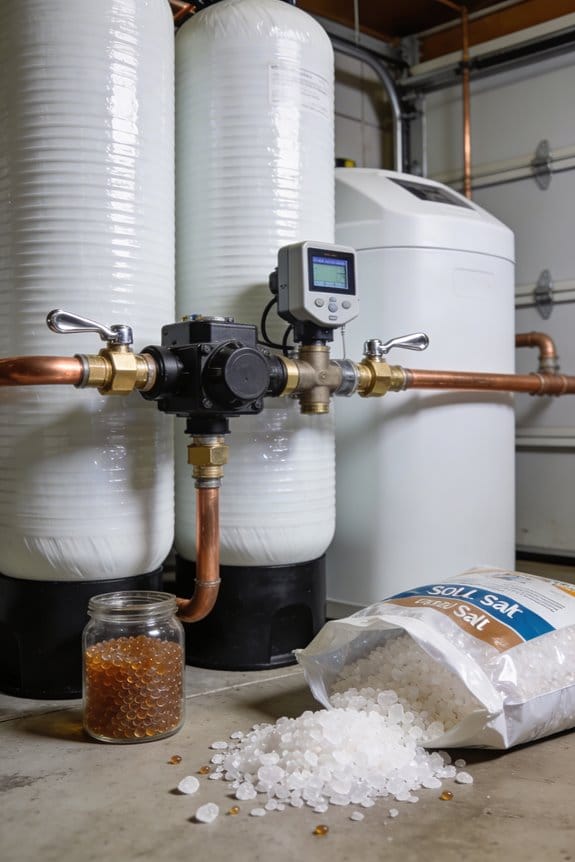

If your softened water’s still hard after regeneration, I’d check five main culprits: low salt levels preventing proper resin recharge, a leaking bypass valve allowing untreated water through, incorrect hardness settings mismatched to your local water supply, salt bridges or mushing blocking brine formation, or exhausted resin beads that’ve lost their ion-exchange capacity. Test your water hardness first to pinpoint the problem, then work through each cause systematically—the solution becomes clearer as you investigate further.
Key Takeaways
- Brine tank salt issues — Low salt levels, salt bridges, or salt mushing prevent proper resin recharging during regeneration cycles.
- Incorrect hardness settings — Programmed hardness levels lower than actual water hardness cause under-regeneration and incomplete softening capacity restoration.
- Valve or bypass leaks — Leaking bypass valves or worn seals allow hard water to bypass the softener, mixing with treated water.
- Incomplete regeneration cycles — Missing rinse phases or cycle overlap during water use leave residual salt on resin, reducing effectiveness.
- Exhausted or fouled resin — Resin beads aged 8–10 years or damaged by iron fouling lose ion-exchange capacity, requiring professional assessment or replacement.
How to Diagnose Water Softener Problems
When your water softener isn’t working properly after regeneration, you’ll want to start by testing your water to see if it’s actually hard or soft. I recommend purchasing a water hardness test kit from your local hardware store, which measures hardness in GPG (grains per gallon). Your treated water should read 0-2 GPG; anything higher indicates a problem.
Next, perform system diagnostics by checking your brine tank salt level and examining for salt bridges or crusty buildup. Inspect all visible connections for leak detection, looking for moisture around seals and valves. Test your water before and after the softening process to pinpoint where the issue occurs. These straightforward checks help identify whether your problem stems from salt depletion, mechanical failure, or incorrect settings.
Test Your Water Hardness: The Diagnostic Starting Point

Testing your water hardness is the most reliable way to confirm whether your softener is actually functioning, and I’d recommend making this your first diagnostic step. You can use inexpensive test strips from your local hardware store to get a quick reading, though they’re less precise than professional options. For accurate results, I suggest sending a sample to a lab analysis service, which gives you exact measurements in grains per gallon (GPG). Your softened water should read 0-2 GPG after treatment. If your readings show 30 GPG or higher post-regeneration, you’ve identified a significant problem. Testing both your incoming water and treated water reveals whether your system’s underperforming or failing entirely, guiding you toward the correct solution.
Recommended Products

THIS KIT ONLY HAS MY GARDEN POOL AQUARIUM AND TERRARIUM TEST STRIPS FOR AQUARIUM TESTING, DOES NOT HAVE 4335 DISKS WHICH ARE REQUIRED FOR THIS DEVICE TO TEST AQUARIUMS PROPERLY. WE ONLY HAVE 4320 DISKS AND TEST STRIPS IN THE BUNDLE

The information below is per-pack only

Low Salt Levels: Why Regeneration Fails

If your softened water still reads hard after regeneration, low salt levels in your brine tank often turn out to be the culprit, because the ion exchange process depends entirely on salt to recharge the resin beads that remove hardness minerals from your water. When you experience a salt shortage, recharge failure becomes inevitable. The resin beads can’t exchange ions without sufficient brine solution, which forms when water dissolves the salt. Additionally, a salt bridge—a hardened crust that forms inside the tank—can block salt dissolution entirely, preventing brine from forming. You’ll notice your brine tank appearing dry or crusty. To resolve this, check your salt level monthly and refill when needed, crushing any bridged salt to restore proper system function and guarantee complete regeneration cycles.
Recommended Products

Perfect for Families: Designed for households of 1–4 people battling hard water. The EcoPure EP31 treats up to 31,000 grains to protect your home from mineral buildup, stains, and scale damage

STOP SCALE BUILDUP: HydroFLOW’s technology prevents scale from forming in your home’s water systems, keeping your faucets and shower nozzles running smoothly and efficiently.

[Revolutionary Water Treatment] Experience unparalleled water quality enhancement with iSpring EDV2 electronic descaler. Say goodbye to hard water woes without resorting to chemicals, salt, or tedious maintenance. Witness a noticeable improvement in just 12 weeks.
Dissolve Salt Bridges and Mushing

Salt bridges and mushing represent two distinct problems that crop up inside your brine tank, yet both stem from the same underlying issue: salt isn’t dissolving properly to create the brine solution your softener needs. A salt bridge forms when salt crusting occurs along the tank’s walls, creating a hollow space that traps moisture underneath. This prevents water from reaching the salt below. Salt mushing, meanwhile, happens when salt crystals clump together into a dense mass that won’t dissolve, even with added water. You’ll notice brine crystallization around the tank’s bottom or sides. To fix either problem, break up the hardened salt using a broom handle or plastic rod. Avoid metal tools that could damage your tank. Once cleared, make certain proper salt management going forward.
Recommended Products

Salt-Free Scale Prevention & Healthy Minerals Retention: Our Whole House Salt-Free Water Softener utilizes an advanced ion exchange resin to effectively inhibit scale formation throughout your home's plumbing and appliances. Unlike traditional softeners, it smartly retains beneficial calcium and magnesium minerals in your water, providing scale-free protection without removing healthy elements
Premium Natural Water Softener - Morton Pure and Natural Water Softener Salt pellets is produced using high-purity, completely natural salt crystals. This premium-quality salt is specifically designed to enhance your water softening system, ensuring better performance and improved water quality throughout your home.

Morton Clean and Protect Water Softener Salt Pellets, 40 LB (Pack-2)
Bypass Valve Leaks: Detecting Hard Water Bleed-Through

Once you’ve addressed salt bridge and mushing issues in your brine tank, you’ll want to examine another common culprit behind persistent water hardness: your bypass valve. This valve controls water flow through your softener, and when it leaks or remains partially open, hard water bypasses the resin beads entirely. During valve inspection, check whether the valve sits completely closed during normal operation. You can perform pressure testing to identify leaks; if hardness levels remain high immediately after regeneration, bleed-through at valve seals is likely occurring. A faulty bypass valve allows untreated water to mix with softened water, defeating your system’s purpose. Make certain the valve closes fully, and consider replacing worn seals or the entire valve if damage is evident.
Recommended Products

Dual alternating tanks never run out of soft water

💧 【 PERFECT FOR 4-6 BATHROOMS 】Rated to treat 64,000 Grains of hardness, this is the professional grade Whole House Water system that delivers high quality filtered, ultra-softened water to every outlet throughout your entire home.

Platinum Air Injection with Filox (Mang-Ox) media for highest removal capabilities
Regeneration Cycle Failures: Missing Steps and Incomplete Cycles
Your water softener relies on a precise sequence of steps during regeneration to restore the resin beads’ ability to remove hardness minerals, and when this cycle fails to complete all its stages, you’re left with treated water that remains hard. An incomplete rinse phase leaves residual salt coating the resin, which then acts as hardness rather than removing it. Cycle overlap occurs when your system regenerates while you’re actively using water, delivering untreated hard water directly to your home. Additionally, if regeneration timing isn’t configured correctly for your local water hardness, the resin exhausts before the next cycle begins. Testing your water before and after treatment reveals the problem—readings above 2 GPG post-regeneration indicate missing or incomplete cycle steps requiring immediate adjustment.
Recalibrate Hardness Settings for Your Local Water
While testing revealed that your water still reads hard after regeneration, the problem might not be a broken cycle at all—it could be that I’ve set the hardness level incorrectly for your specific water supply. Your water softener needs accurate calibration adjustment based on your local hardness, which varies by region and even neighborhood. I can determine your water’s actual hardness by testing it before treatment, then adjusting the system settings accordingly. If I’ve programmed the machine for lower hardness than what you actually receive, the resin won’t regenerate enough to handle the minerals present. Contact your local water utility for hardness data, or have me perform a professional test to confirm proper local hardness calibration.
Clean Your Clogged Brine Tank
If your water softener continues to deliver hard water even after regeneration, the brine tank itself may be the culprit, as sludge, mineral buildup, or salt mushing can block the system from drawing salty water needed for the regeneration process. I recommend inspecting your brine tank for these blockages, which prevent proper brine formation.
Start by disconnecting power and taking safety precautions before opening the tank. Remove any clumped salt or debris you find inside. If you notice tank odor or visible sludge, flush the tank thoroughly with clean water. Check the float valve mechanism to guarantee it moves freely. These maintenance steps restore proper brine flow, allowing your softener to complete regeneration cycles effectively and resume delivering genuinely soft water throughout your home.
Resin Bed Fouling: Why Iron Destroys Water Softening
Iron deposits accumulate on resin beads through a process called fouling, which severely compromises your water softener’s ability to remove hardness minerals. When your water contains iron, it undergoes iron oxidation—a chemical transformation that causes the iron to stick permanently to the resin beads’ surface. This buildup, known as resin poisoning, creates a barrier that prevents the beads from exchanging ions effectively.
You’ll notice fouling when your softened water remains hard despite regeneration cycles. The resin beads can’t function properly because iron coatings block mineral removal. Unlike standard hardness minerals that wash away during regeneration, iron deposits require specialized cleaning solutions designed specifically for iron removal. If you suspect iron fouling, you may need professional intervention or resin bed revitalization to restore your system’s performance.
Recommended Products

COMPLETE PACKAGE - Complete package that includes a whole house Water Softener w/ UPGRADED Purolite C100E US made resin & Upflow Carbon Filtration System. Our package also includes an installation manual and technical support. Silicone lubricant and hardness test strips for the PERFECT install!
COMPLETE PACKAGE - Complete package that includes a whole house Water Softener w/ UPGRADED 10% resin & Upflow Carbon Filtration System. Our package also includes an installation manual and technical support. AFW Filters water bottle included with system. Water bottle has sanitizer pack, silicone lubricant, and hardness test strips for the PERFECT install!

Powerful Softening: This water softener system reduces over 90% of calcium and magnesium ions from hard water, effectively reducing scale buildup. The 2.12cu. ft. resin can treat up to 64,000 grains of hardness, ideal for small to mid-size households
Does Your Water Softener Need New Resin?
After iron fouling damages your resin beads, you’ll eventually face a more permanent question: whether your resin bed requires complete replacement. Most resin has a typical lifespan of 8-10 years, depending on your water quality and regeneration frequency. If your softener continues producing hard water despite proper settings and maintenance, your resin beads may be exhausted. Bead replacement becomes necessary when the resin can no longer exchange ions effectively, even after cleaning cycles. You’ll notice this when hardness levels remain high post-regeneration consistently. Professional testing can confirm whether revitalization helps or if bead replacement is your only solution. Replacing your resin bed restores your system’s full softening capacity and effectiveness.
Frequently Asked Questions
How Often Should I Schedule Professional Water Softener Maintenance to Prevent Hardness Issues?
I’d recommend scheduling annual checkups with seasonal inspections to prevent hardness issues. Professional maintenance catches salt bridges, resin fouling, and regeneration failures before they compromise your water softening performance.
Can Water Softener Problems Indicate a Need to Replace the Entire System Versus Repair?
Your softener’s struggles can be a fork in the road: repair or replace. I’d suggest reviewing your warranty first—it’s your financial compass. If you’re facing resin bed exhaustion or multiple component failures, replacement often makes economic sense.
What Is the Ideal Water Hardness Level I Should Target After Proper Softening?
You’ll want to target a hardness level of 0-2 GPG (grains per gallon) as your ideal range after softening. I’d recommend testing your treated water regularly to make sure you’re hitting that target consistently.
How Long Does a Typical Water Softener Regeneration Cycle Take to Complete?
I’ve found that most regeneration cycles take two to four hours total. The regeneration timing involves several cycle stages: backwash, brining, rinsing, and fast rinse. Your system’s exact duration depends on tank size and settings.
Are There Water Additives or Pre-Filters That Help Protect My Softener From Damage?
I’ll gently guide your system toward longevity. Sediment prefiltration removes particles that foul resin, while polyphosphate dosing conditions water upstream, protecting your softener from premature wear and buildup complications.