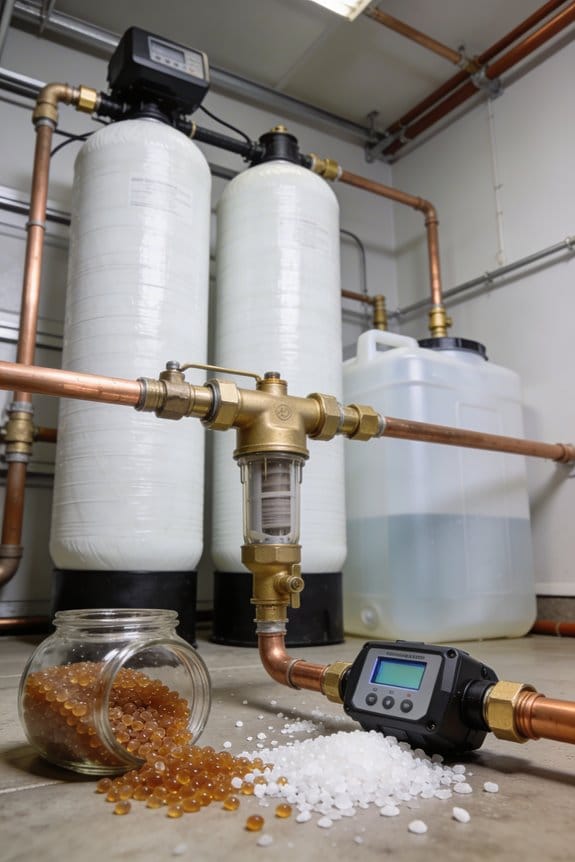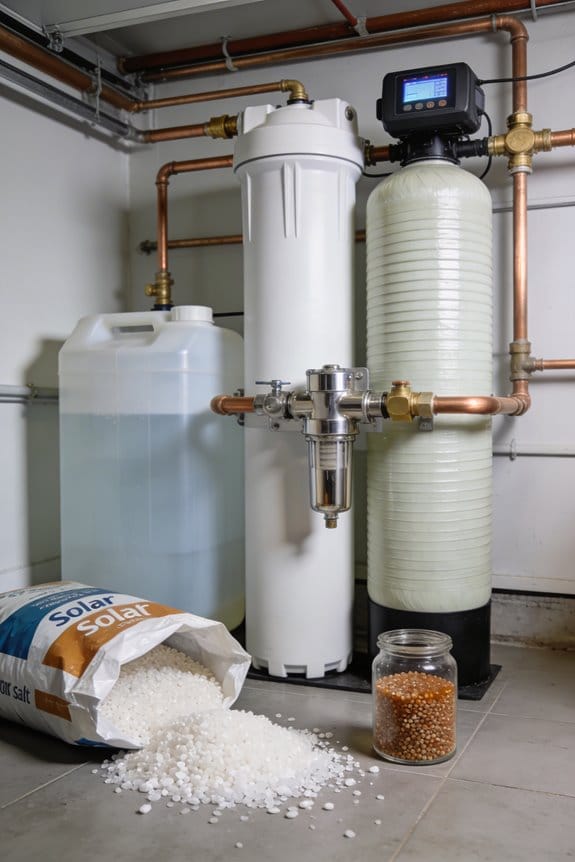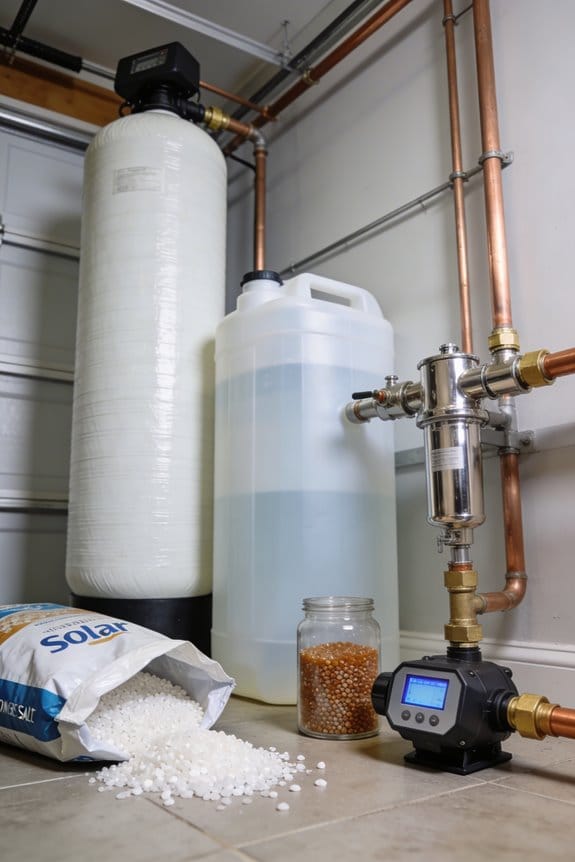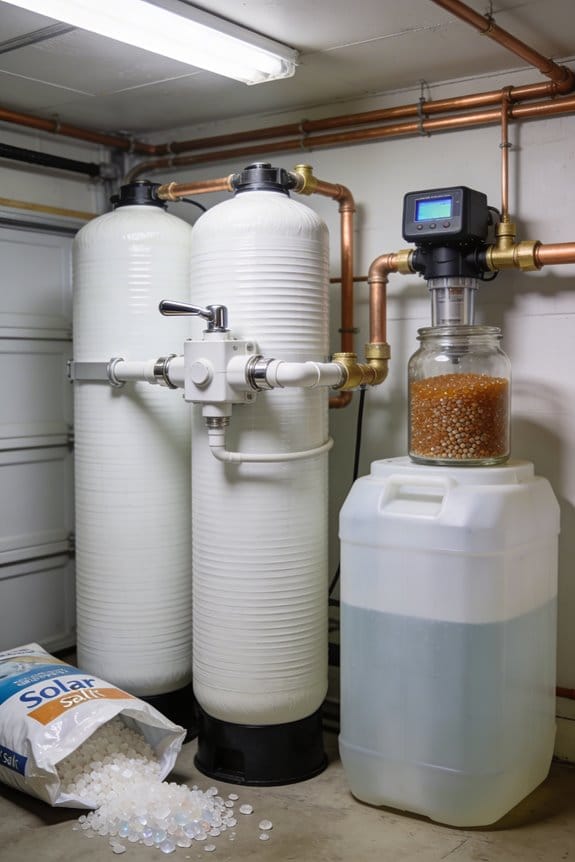
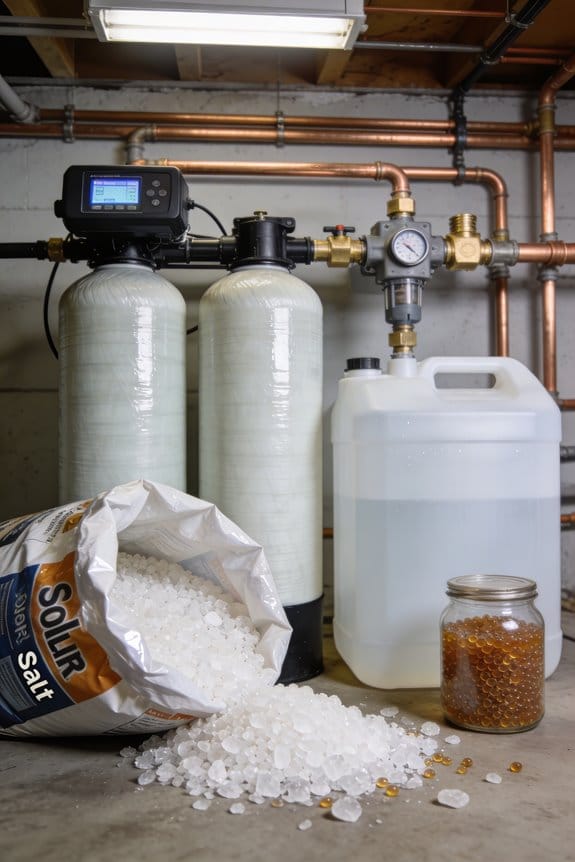

Your water softener’s increased salt use typically stems from five main issues. Internal cabinet leaks allow water to bypass the resin chamber and dissolve salt directly. Faulty brine valves prevent proper brine injection during regeneration cycles. Your water might contain higher hardness or iron content than your system was designed for. Misaligned regeneration settings can trigger unnecessary frequent cycles. Household leaks, like running toilets or dripping faucets, force your softener to work overtime. Understanding which problem applies to your situation will help you pinpoint the exact cause.
Key Takeaways
- Internal cabinet leaks or faulty brine valves allow water to bypass the resin, dissolving salt directly and increasing consumption.
- High water hardness or iron content in your water requires more salt per regeneration cycle to soften effectively.
- Household water leaks from toilets, faucets, or pipes increase overall water usage, triggering more frequent regeneration cycles.
- Regeneration settings may be too frequent; check gallons-per-day and cycle timing to ensure they match actual household usage.
- Undersized resin tank capacity relative to daily water usage forces the system to regenerate more often than necessary.
Calculate Normal Salt Consumption for Your System
Before you can determine whether your water softener’s using too much salt, you’ll need to know what “normal” consumption actually looks like for your specific system. The salt math is straightforward: multiply your resin capacity by the standard salt requirement per regeneration cycle. For example, a 1-cubic-foot system typically uses 9 pounds of salt per regeneration, while a 1.5-cubic-foot system uses 12 pounds, and a 2-cubic-foot system uses 15 pounds. Next, estimate how many times your softener regenerates monthly based on your household’s water usage. Multiply the salt per regeneration by your monthly regeneration cycles to establish your baseline consumption. This calculation gives you a realistic target, helping you identify whether actual usage represents normal operation or signals a problem requiring investigation.
Spot Internal Cabinet Leaks and Faulty Brine Valves

Once you’ve calculated your system’s normal salt consumption, the next logical step is to identify whether internal leaks or faulty components are causing excess salt loss. I’d recommend checking your brine tank’s water level first—if it’s unusually high, you’ve likely got an internal cabinet leak. This happens when water bypasses the resin chamber and enters the brine tank directly, dissolving salt without proper brine formation. You should also inspect your valve malfunction signs, including weak water pressure or salt water appearing in your softened water. A faulty brine valve prevents proper brine injection during regeneration, forcing your system to work harder. Listen for continuous valve clicking or hissing sounds, which indicate valve malfunction. Address these issues promptly to prevent brine leakage and unnecessary salt waste.
Recommended Products

Complete Twin tank water softener provides continuous soft water

💧 Perfectly designed for 4-6 bathrooms homes, the Aquasure Signature Series is the professional grade Whole House Water system that delivers high quality filtered, ultra-softened water to every outlet throughout your entire home. No need for manual regeneration, backwash, draining, this system automatically regenerates and backwash, making it cost efficient and easy to maintain.

64k Digital Dual Tank Alternating IRON PRO Water Softener with Fleck 9100SXT
Test Your Water’s Hardness and Iron Content

After you’ve addressed any leaks or valve problems, the next step is to understand what’s actually in your water, since the hardness level and iron content directly affect how much salt your softener needs. I recommend getting your water tested to determine hardness levels, which have a linear effect on salt usage—400ppm hardness requires twice the salt as 200ppm for identical water volumes. Iron staining on fixtures or clothing signals iron presence, which coats resin beads and forces more frequent regenerations. Hardness mapping through testing reveals exactly how much mineral content you’re dealing with, allowing you to adjust your system’s settings accordingly. Professional water testing provides accurate measurements, helping you identify whether excessive salt consumption stems from high mineral content rather than equipment malfunction.
Check Your Salt Regeneration Settings
Now that you understand your water’s mineral content, I recommend examining your softener’s regeneration settings, because these controls determine how often and how intensely your system runs its cleaning cycles. Your cycle timing—whether your system regenerates every three days or seven days—directly impacts salt consumption. If you’re running unnecessary cycles, you’re wasting salt unnecessarily. Check your sodium dosage setting, which controls how much salt enters the brine tank per regeneration. Most systems use between nine and fifteen pounds per cycle, depending on tank size. Review your gallons-per-day setting and hours override; if these values are set too low, your softener regenerates excessively. Adjusting these parameters to match your actual household water usage greatly reduces salt waste while maintaining proper water softening performance.
Recommended Products

💧【 IDEAL FOR 4-6 BATHROOMS 】The Aquasure Harmony Series is engineered to handle up to 70,000 grains of hardness by removing skin damaging hard minerals like calcium and magnesium, providing professional-grade softened water to every outlet throughout your home.

Smart Whole-Home Water Softening for 5-6 Person Households: This 40,000-grain water softener system is designed for households of 5 to 6 people, delivering consistent soft water throughout your entire home - from showers and sinks to laundry and dishwashers. As a comprehensive whole-house solution, it effectively reduces hard water minerals to combat scale buildup, water spots, and stiff fabrics, while extending the life of water-using appliances like water heaters and washing machines
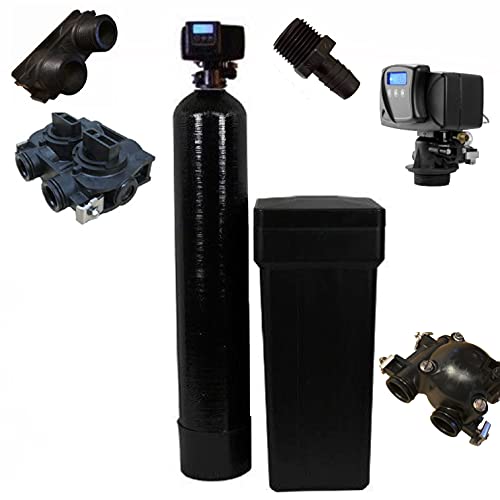
Reliable Fleck 5600 SXT Digital Control Valve: Features the industry-trusted Fleck 5600 SXT digital metered control valve known for durability and reliability in water softening applications
Match System Capacity to Household Water Usage

Your water softener’s capacity must align with your household’s actual water consumption, because a system that’s undersized or oversized—or simply misconfigured—will regenerate inefficiently and waste excessive salt. An undersized system regenerates too frequently since it can’t handle your family size’s daily flow rates, forcing the resin to exhaust faster. An oversized system may regenerate less often, but if the gallons setting is programmed too low, you’ll trigger unnecessary cycles anyway. I recommend calculating your household’s average daily water usage based on family size and multiplying by peak usage periods. Most families use 75-100 gallons per person daily. Match your system’s cubic footage capacity to this figure, then adjust your controller settings accordingly to minimize regenerations and salt waste.
Find Water Leaks Causing Extra Regenerations
Even small leaks throughout your home can add up to significant water waste, and they’re often the culprit behind your water softener‘s unexpectedly high salt consumption. Running toilets, dripping faucets, and hidden leaks force your softener to process more water than normal, triggering extra regeneration cycles that deplete your salt supply faster.
To identify leaks, check your water meter before and after a two-hour period when no one’s using water. A higher reading indicates a leak. Look for wet spots under sinks, around toilets, and in basements. Don’t overlook outdoor sources like garden irrigation systems, which bypass your softener entirely but increase overall household water demand.
Fixing leaks promptly reduces unnecessary regenerations and restores normal salt usage patterns.
Recommended Products

PREVENT MOISTURE PROBLEMS: A mobile non-destructive impedance moisture detector designed to survey moisture content in flat roofing & waterproofing systems (as per ASTM D7954); ideal for water leak detection in roofing materials & integrity testing

Solid aluminum construction housing contains circuitry, controls and meter: Weight 2.5lbs. Dimensions: 3" x 6" x 10"

Model E6-XT: Handheld IR camera measures temperatures from -20°C to 550°C (-4°F to 1022°F)
When to Upgrade From Time-Clock to Metered Systems
If your water softener runs on a time-clock system that regenerates on a fixed schedule every three to seven days, upgrading to a metered on-demand system could markedly reduce your salt consumption. Time-clock systems regenerate regardless of actual water usage, wasting salt during low-usage periods. Metered systems employ demand sensing technology to track water consumption in real time, triggering regeneration only when necessary. This usage tracking capability guarantees your system regenerates based on genuine hardness removal needs rather than arbitrary timing. If your household water use varies substantially or remains consistently low, a metered upgrade pays dividends through reduced salt waste and lower operational costs over time.
Recommended Products
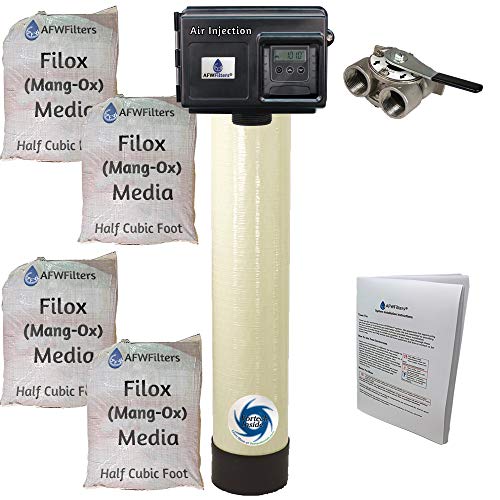
DIY install with supplemental instructions by AFWFilters

Dual alternating tanks never run out of soft water
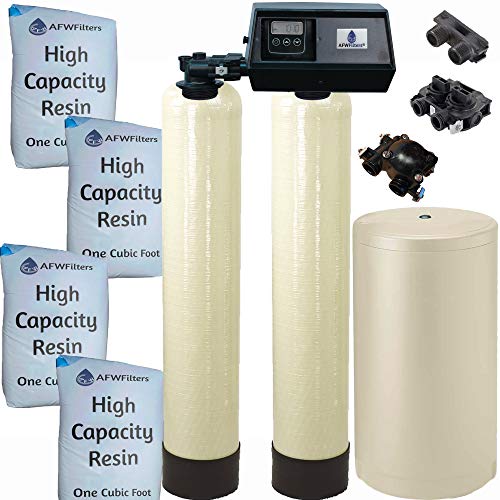
Dual alternating tanks never run out of soft water
Reduce Salt Waste With Proper Maintenance and Filtration
Beyond upgrading your system type, I’ve found that regular maintenance and strategic filtration work together to minimize salt waste at the source. Scheduled inspections catch leaking valves or controls before they cause overflow problems that drain your brine system prematurely. During these inspections, I check for internal cabinet leaks and verify that regeneration settings match your actual water usage patterns.
Media cleaning removes iron buildup that forces unnecessary regenerations, directly reducing salt consumption. Installing iron filtration ahead of your softener prevents iron from coating resin beads, which otherwise demands more frequent cycles. This two-step approach—maintaining your current system while filtering problematic water quality—addresses waste efficiently without requiring expensive equipment replacement.
Recommended Products

The WECO Backwashing filter with KL/OZ is a specialized Point-Of-Entry (POE) system designed for municipal and well water supplies. Utilizes iron reduction media consisting of manganese dioxide (MnO2) coated onto naturally mined ZEOSORB. Lightweight filtration media with various functions and properties for water treatment and remediation.

High removal capacity of iron, manganese, hydrogen sulfide. Removes suspended solids and turbidity.

Point-Of-Entry (POE) whole house residential/commercial hydrogen sulfide and iron removal system for community and well water supplies.
Frequently Asked Questions
How Much Sodium Does a Water Softener Add to Drinking Water per Glass?
Your softener adds about 20.6mg of sodium per 8oz glass when treating 11gpg hardness water. While this sodium content’s minimal for most people, I’d recommend discussing health concerns with your doctor if you’re sodium-sensitive.
Can I Reduce Salt Usage by Installing Iron Filtration Before My Softener?
Installing iron prefiltration is your salt-saving silver bullet. I’d recommend it because iron coats resin beads, forcing wasteful regenerations. By filtering iron first, you’ll protect your resin longevity and dramatically slash salt consumption.
What’s the Difference Between Single-Tank and Twin-Tank Water Softening Systems?
A single tank regenerates on a fixed schedule, leaving you without soft water during maintenance intervals. A twin tank system operates on continuous duty, alternating between softening and regeneration so you’re never without soft water.
Does Reverse Osmosis Remove Sodium Added by Water Softeners?
Yes, reverse osmosis effectively removes sodium added by water softeners through sodium rejection. I’d recommend installing RO post-softener if you’re concerned about sodium intake, ensuring excellent reverse osmosis compatibility with your softening system.
How Should I Track Salt Usage to Identify Unusual Consumption Patterns?
I’d recommend keeping weekly logs of your salt levels and creating usage charts to spot spikes. Compare consumption patterns month-to-month—sudden increases signal potential leaks or system malfunctions needing investigation.